
The Wells Record - Torture Networks, Policing, Prisons
State Torture as Social Work

Welcome - About The Wells Record
The Wells Record tracks global news on the human infrastructure of state violence.
Ida B. Wells, trailblazing journalist, organizer and publisher, inspired this effort and the book that preceded it, Torture in the National Security Imagination.
Curating news, human rights monitoring, analysis and reviews, The Wells Record points up state torture as a process and a deliberate and daily social practice, not an isolated incident.
Torture thrives globally because it has carved out local social functions and (putative) benefits.
To document this fact, Wells traveled the U.S. to the still-volatile sites of recent lynchings, doggedly investigated, and delivered terse unsparing analysis.
She revealed lynching torture as a social strategy: this was a public-private collaboration in wholesale racial terror, yes, but also the most complete and deadly form of economic competition, and a tool of white ethno-racial community building.
Wells, later Wells-Barnett, campaigned abroad to declare lynching an international disgrace, demanding economic sanction.
Global State Torture, Police & Prison Systems: Torture as Social Work
We are conditioned to see targeted violence as an incidental excess, as “brutality,” not as torture and part of a routine way of conducting operations. But torture is wedded to our culture of confinement and fuels it.
Globally, state torture takes many forms and serves many social purposes, used often to:
Dominate people and places, viscerally and politically
Solidify group identity, mark out subordinations of caste, control territory
Chill dissent, terrorize groups, undercut economic and political activity
Accomplish organizational goals, close cases, marshal authority, administer “order”
Garner economic, personal and professional benefits
Networks: The Human Infrastructure of State Violence
Networks of people—lawyers, recordkeepers, officers and bureaucrats--make state torture possible. Pursuing context matters.
Policing, military, detention, prisons: Tracking organizational cultures of capture and confinement, of discretion as violence and domination.
Administrative teams, incentives and permission structures: Analyzing the legal and bureaucratic systems, constraints and protocols that reward or support systematic harm.
Security narratives, interorganizational commerce and exchange: Identifying markets for force and geopolitical alliances for training and equipment.
Public complicity and support: Challenging political discussion and media conventions that misname, euphemize, or evade.
The Human Cost
Torture delivers enormous interpersonal, intergenerational harm and institutional corruption.
Never neutral, state violence targets marginalized groups, attacking them deliberately in particularly racial, gendered, religious, economic and many other ways. Survivor care is a massive and essential responsibility for us all.
Attending to the networks and social functions of torture deepens understanding of our own complicity. It empowers us to move the work of accountability forward.
Human Rights Prohibitions on Torture & Anything Close to Torture
United Nations Convention against Torture and Other Cruel, Inhuman or Degrading Treatment or Punishment (CAT and CIDTP).
Global News
Roma Couple Win Case Against Police Torturers in Serbia
Source: Roma Tortured by Serbian Police Win Case at European Court
17 February 2026 | European Roma Rights Centre
Tags: Accountability, Torture teams, Policing, Serbia
Years after Romani couple Marko and Sandra Stalović were held without charge in Belgrade, the European Court of Human Rights has found Serbian police officers subjected them to torture and inhuman and degrading treatment in 2017. Police and the public prosecutor were also faulted for ineffective investigation of this crime.
“They trusted the system and that trust was weaponized against them.”
The pair had sought out local police to report their car stolen but then were driven 49 miles in an unmarked car to a precinct in Belgrade with a years-long reputation among human rights monitoring organizations for impunity in the face of routinized violence against those in custody. There Marko was surrounded by eight officers, forced into stress positions, beaten, whipped across the hands, suffocated with plastic, and threatened with a gun to his head while Sandra Stalović was forced to listen. Both endured racial, ethnic and religious abuse; perpetrators threatened their children and forced them to sign false documents. The court issued a monetary judgment.
“Nearly nine years on, not a single officer has faced consequences for his actions. What makes this case particularly chilling is that Marko and Sandra actually called the police themselves in the first place to report a crime” — Human rights lawyer Andrea Čolak, working with European Roma Rights Centre.
Full-body WRAP restraint linked to ICE deaths, police and jail fatalities
Source: Citing AP investigation, new bill seeks to prohibit DHS from using full-body restraints
25 Feb 2026 | Associated Press / Santa Cruz Sentinel
Tags: Weapons and restraints, Accountability, Policing, ICE
Illinois representative promotes new legislation to ban US Immigration and Customs Enforcement and Homeland Security use of the full body “WRAP” device. The immobilizing restraint is used increasingly by local police and jails. An Associated Press report has linked the WRAP to a dozen deaths. It is manufactured by Safe Restraints Inc., of California.
Additional links
Associated Press report on ICE fatalities and the WRAP
Corporate marketing videos from Safe Restraints Inc.
CPJ documents torture experience of 59 Palestinian journalists held by Israel
Source: ‘Torture, threats, rape’: Palestinian journalists detail Israeli jail abuse
19 February 2026 | Al Jazeera
Tags: Committee to Protect Journalists; Political repression; Israel; Sde Teiman
Al Jazeera staff lend context to a February 19 report of the International Committee to Protect Journalists.
“Sexual violence appeared repeatedly in the testimonies, with journalists describing assaults as intended to humiliate, terrorise and permanently scar them.”
The group interviewed 59 Palestinian journalists imprisoned by Israel after the brutal Hamas-led attacks of October 2023. Fifty-eight reported “torture, abuse or other forms of violence” including baton beatings, electroshocks, rape, excruciating stress positions, immersion in sewage. The journalists lost an average of 54 pounds (23.5 kilos) in custody.
UK complicity case compensates Abu Zubaydah - subject of US torture, 24-year detention
Source: Guantanamo detainee paid “substantial” compensation by UK to settle torture complicity case.
11 January 2026 | BBC
Tags: Accountability; United Kingdom; United States; Guantanamo
The UK settled a civil case brought by Saudi Palestinian Abu Zubaydah. British intelligence agencies MI5 and MI6 were aware of the ongoing CIA torture program and collaborated in violent interrogation of Saudi Palestinian Zubaydah.
“These violations of his rights are not historic, they are ongoing.”
The US has withdrawn claims that he was a member of al-Qaeda yet continues to hold him prisoner without charge or trial at Guantanamo Bay. The US Senate and UK parliamentary reports of 2014 and 2018, respectively, documented that he was waterboarded 83 times, locked in cramped boxes and assaulted physically in a variety of ways.
“The compensation is important, it’s significant, but it’s insufficient.” - Prof. Helen Duffy, international legal counsel for Zubaydah.
Additional links
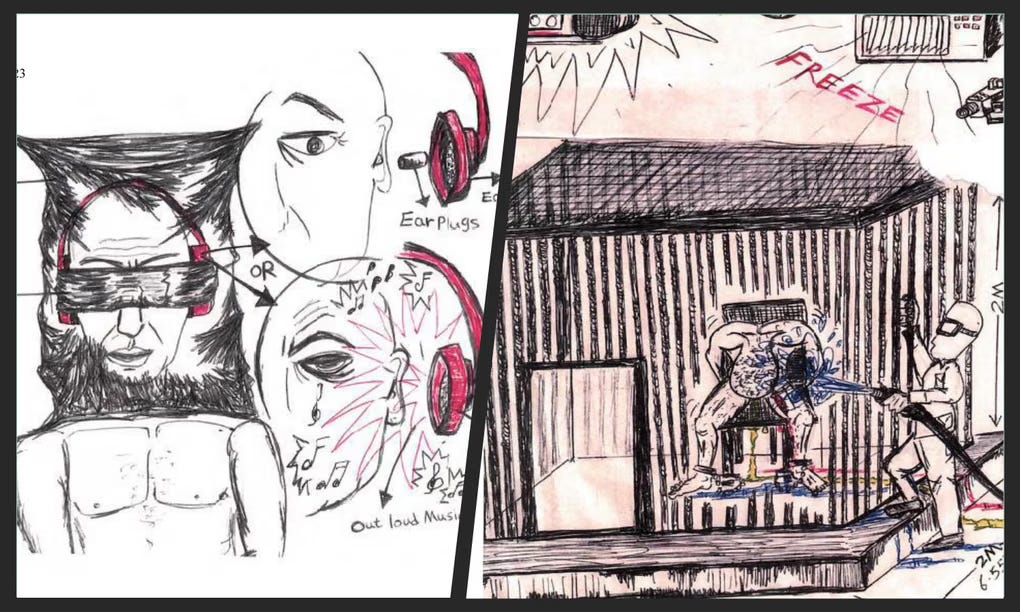
Sharp rise in forced confessions broadcast on Iranian state TV intensifies long pattern
Source: Activists say Iran has aired at least 97 coerced confessions from protesters, often after torture
13 January 2026 | Associated Press / WSLS, Roanoke VA
Tags: Torture broadcast; Execution; Iran; Political repression
The AP recorded a rising number of arrests and confessions linked to torture broadcast in the immediate wake of the nationwide protests that began on Dec. 28. The surge is relative to similar Iranian state broadcasts over the course of the last fifteen years. The article also cites the UN’s count of 975 state executions in 2024.
“The nearly 100 confessions broadcast over just two weeks is unprecedented for Iran” – Human Rights Activists News Agency, deputy director
Warning for Ireland on Police Shock and Spray Devices
Source: Ireland: Gardaí less-lethal weapon expansion poses grave human rights risks, warn UN experts
18 February 2026 | UN Office of the High Commissioner of Human Rights
Tags: Weapons and arms, Ireland, Policing, Torture markets
“[Experts] were dismayed at the information by the Gardaí that these [shock] weapons could be used against pregnant women and the elderly.”
UN human rights and weapons experts issued a warning notice concerning the acquisition of dangerous crowd control devices by the Gardaí, the National Police of the Irish Republic. UN experts noted the injury of peaceful protesters in October 2025, allegedly caused by ‘double-strength pepper spray’ (product name: SABRE Red Crossfire MK‑3 Gel), and added that the Gardaí have also invested in taser-like Conductive Energy Devices (CED) designed to deliver electric shocks when pressed against the body. CED fall under the “preliminary list of items identified by the Special Rapporteur on torture as being inherently cruel, inhuman or degrading and therefore considered to be prohibited,” they said.
Guantanamo Update: US Appeals 2025 Military Court Finding of Torture
Source: War Court Prosecutor Asks Panel to Overturn Torture Finding in 9/11 Case
27 February 2026 | New York Times
Tags: Al Qaeda, Torture teams, Black sites, United States
The US government asked a Pentagon review panel to overturn a 2025 decision that excluded from trial a confession obtained by CIA torture. That statement, contended the military commissions prosecutor, remains the “best evidence” against Ammar al-Baluchi, one of five alleged members of the 9/11 hijacking plot of 2001. All have been held over 20 years without trial. Contention over agency torture continues to dog and delay the case against them. Before his transfer to Guantanamo, Al-Baluchi was held in CIA black sites for years, kept standing, chained and naked for more than three days without sleep, subjected to drowning in ice water, held in darkness for five months, and repeatedly “walled” (head slammed against the wall) until his interrogators grew tired.
Books
Prisons: Of political philosophy and our own backyards
Source: There are more prisons in heaven and earth, Spencer J. Weinreich reviews The Prison before the Panopticon: Incarceration in Ancient and Modern Political Philosophy by Jacob Abolafia
March 10, 2026 | Public Books
Tags: Political philosophy, Prison abolition, Incarceration
Reading Abolafia’s 2024 study with appreciation, Weinreich charts the book’s course down two paths of Western political philosophy. Both take the prison as a necessary touchstone, whether the philosopher is ruminating on tensions facing the authority of the state or on the moral psychology of reform. While prisons may persist, he says, as a critical puzzle for political philosophy, Weinreich points to actual prisons and prisoners as the very engine of today’s politics. The “untidy violence” of prisons leaves little room for nuance and powerfully shapes our lives.
“The prison and its outriders—policing, probation, parole, bail, surveillance—have become many citizens’ most immediate and most meaningful encounters with the state. Entire realms of the political, such as migration, are framed in carceral terms. The prison poses an anomaly for representative democracy, its inmates usually deprived of the right to vote but counted for purposes of gerrymandering. Contemporary political economy must account for...the vast economic ecosystem, of caterers and internet service providers and architects, sustained by the public money poured into prisons...The fact that one in every three American adults has a criminal record demands a whole new account of citizenship and its relationship to punishment.”
Historical
Read Writing by Ida B. Wells
Southern Horrors: Lynch Law in All its Phases (1892, 1893, 1894)
The Red Record: Tabulated Statistics and Alleged Causes of Lynching in the United States (1895)
Thank you for reading The Wells Record! Please share, comment or subscribe.